

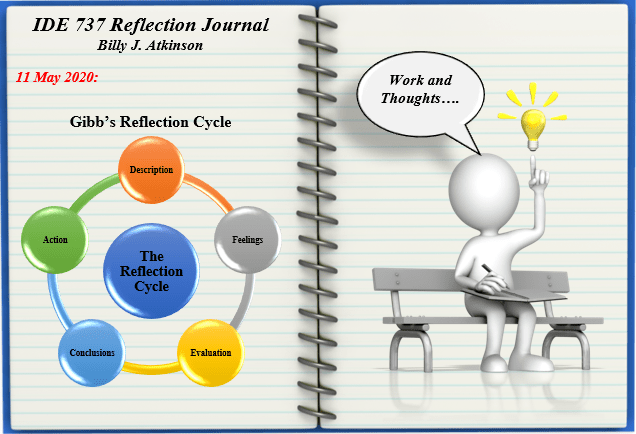
May 11, 2020
Getting Started….
Unit one (Reflection Journal Tutorial):
- What should I include in my reflection journal? There are many things that should be included in your journal, which include your work and thoughts about specific activities, assignments, readings, and discussions. Including these will help you reflect and think about your work resulting in a better understanding and deeper learning experience.
- Why is it important to take notes in my journal when I am reading or completing an activity or assignments? One of the most important reason for taking notes in your journal is to help with learning and understanding the material that you are working on. This includes writing and using graphics or photos to help with documenting the most important or critical information that you have identified. Doing this will allow you to have quick and easy access to this information when working on other projects and assignments.
- Why do I need to integrate graphics, photos, links to online resources, etc. in my journal? Sometimes graphics and photos say more than words and easier to understand the process. Using photos and graphics can give you a visual representation of the information and can assist with retaining and storing the information. Including links to online resources will help you document these critical resources to assist in quick and easy access for future work or projects.
- Why is it important to talk about my feelings in my journal? Including your feelings within your journal can assist with understanding your feelings while working on certain assignments, projects, collaboration sessions, etc. Talking about your feelings in your journal can help think about why certain thinks happened, why do you feel this way, and what can you do differently. Ultimately, reflecting on these feelings can help sustain or improve your learning and performance.
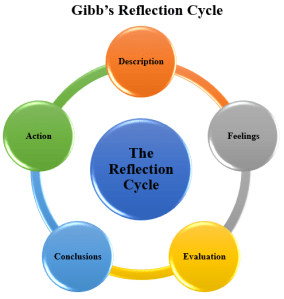
- What is the value (or not) of a reflection journal? Regardless if it is a good or bad experience, its is important to keep a reflection journal. Reflecting on your experiences will allow you to self-reflect and learn on your past experiences. This will allow you to identify areas that need improvement and areas that you can sustain. Documenting these experiences with writing, graphics, charts, photos, clip arts, etc. will allow you to reflect on your journey before, during and after. A good model to use with the reflection journal is Gibb’s Reflection Cycle which is a five step cycle as seen below (website link on graphic).
My Thoughts….

Throughout my journey in the IDD&E Program I have kept a digital journal for each of my courses and I do believe that this tool has assisted me on my learning experiences. Incorporating a reflection journal in my final project will bring a great benefit in my studies.
Selecting an Instructional Unit….
(11:20 AM) Having a difficult time selecting an instructional unit for my final project. I am contemplating in selecting an existing instructional unit (Army Course) or creating an instructional unit from my FEA plan in IDE 712. I reached out to Erric and Chuck (both classmates) for ideas, which did help as they shared their selections.
(2:00 PM) After thinking of my options, discussing with my classmates, and discussing with my wife, I have chosen to create an instructional unit for one of the areas I have identified needing an instructional intervention to close a current performance gap within my Front-End Analysis Plan in IDE 712. Developing Training Plans.
Online Case Study….
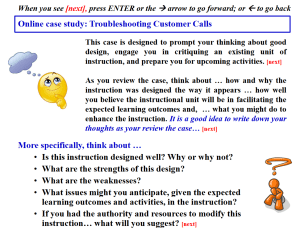
- Overall, is this case instruction designed well? Why or why not? Presentation included videos demonstrating/modeling successful customer service calls, facilitator involved learners by asking prompting questions about each session (what behaviors they noticed). Demonstration includes demonstration video and the facilitator pauses to create discussions with learners (questions/answers). Debrief allows for learners to reflect on the instructions received by sharing their thoughts and experiences. Facilitator guides discussions by asking questions to engage the learners. No assessment was conducted to verify that the learners were/able to achieve each objective and goal.
- What are the strengths and weakness of this design? Strength: Facilitator engages learners with questions for discussions, videos demonstrate correct procedures (modeling) and facilitator pauses to discuss (engaging learners) Weaknesses: Instructional unit does not allow opportunity for the learners to practice their skills (Merrill’s First Principles).
- What issues might you anticipate, given the expected learning outcomes and activities, in the instruction? Mistakes by the learners as there was no opportunity to practice the skills instructed and received. Facilitator never verified if the learners can achieve each objective and the goal.
- What suggestions do you have to enhance this instruction? Incorporate opportunities for learners to practice their skills, consider including role playing or real world scenarios to enhance learning experiences. Additionally, incorporating videos showing some common mistakes/unwanted behaviors can allow for discussions to what was observed that was incorrect. Lastly, incorporating an assessment to verify each learner will be able to achieve each objective and the goal.
May 12, 2020
Instructional Unit Outline….
What instructional unit comes to mind now? Developing Physical Readiness Training Plans
Cause: Training Errors due to the lack of knowledge and skills to develop and execute training plans. Theses training errors cause common injuries that prevent individuals from meeting and achieving job requirements.
Solution: Requires instructional intervention. Developing an online course to educate and certify leaders.
What is the content of the unit and what expertise do you have in this content? Educating leaders on developing structured and strategic training plans to avoid/decrease injuries and increase/improve work production and performance. I am very familiar with this topic and have several years in creating and executing training plans. Currently, create my own training plans that require placing the right running workouts, strength training, flexibility, and muscle therapy that decrease the risk of injuries while increasing/improving performance.
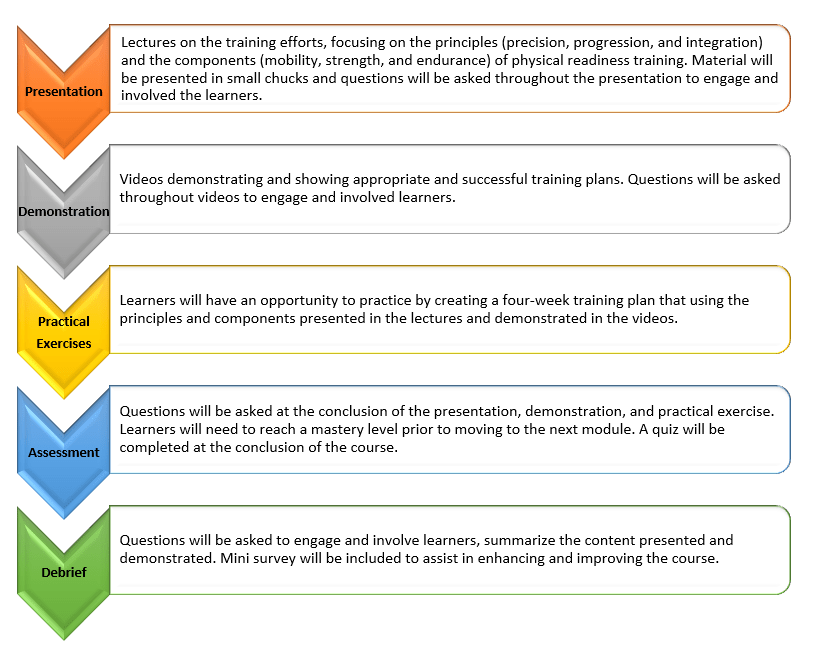
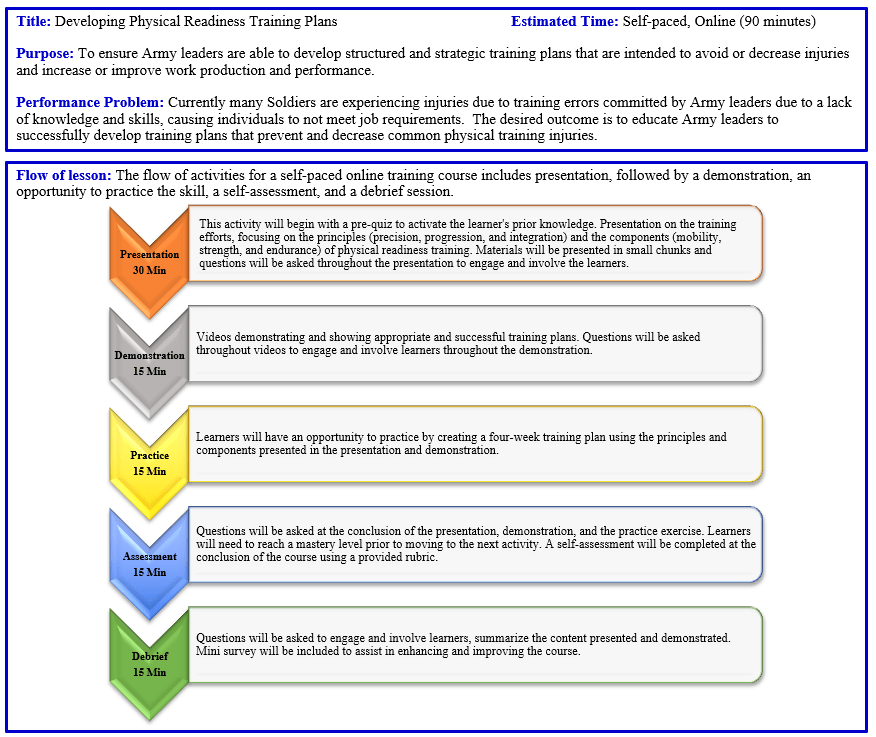
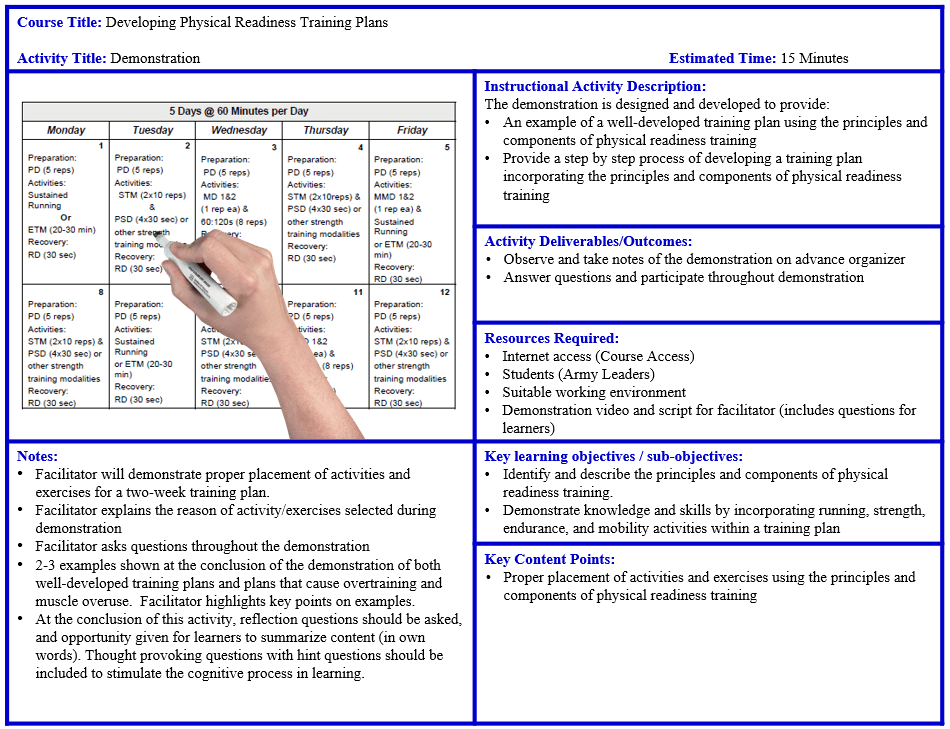
What is (or will be) the flow of activities in this unit and can you describe the unit as including all or most of these types of activities? Presentation, Demonstration, Practical Exercises, Assessment, and Debrief.
Instructional Goal: Army leaders create and execute structured and strategic training plans to avoid/decrease injuries and increase/improve work production and performance.
What are the learning objectives for your unit?
- Learners will identify and describe the principles and components of physical readiness training.
- Learners will be able to create a four-week training plan that incorporates the principles and components of physical readiness training.
- Learners will be able to demonstrate their knowledge and skills by incorporating running activities, strength and mobility activities, and endurance and mobility activities withing a four-week training plan.
How is the unit you are thinking about delivered? Self-paced (online) and broken down into three main components (presentation, demonstration, and practice).
What is the format of the unit you are thinking about? Online course, this method will be best to educate a large number of leaders and will be cost effective as well.
Instructional Strategies:
- Presentation (Lecture)
- Demonstration
- Develop (reflection)
- Questions and Answers
At the completion of unit one and prior to video session one, I have a good feeling about my project. I do believe this project will allow me to showcase the knowledge and skills I have gained throughout the IDD&E program. I am excited to start my storyboard and receiving feedback on my current progress from the professor and other classmates.
May 13, 2020
Video Session One….

(0927 AM) A little nervous about today’s video session, just want to ensure the instructional unit I selected will meet the intent of my final project. I do believe it will, so looking forward to the comments and feedback I receive from the professor and my classmates.
(0950 AM) I have tested my technology equipment and I am prepared for the video conference that will begin momentary.
(1000 AM) Video Residency Session (VS1) started with an introduction. Great opportunity to meet some other classmates that are not part of the fellowship program (military) and hearing the different instructional units other classmates selected.
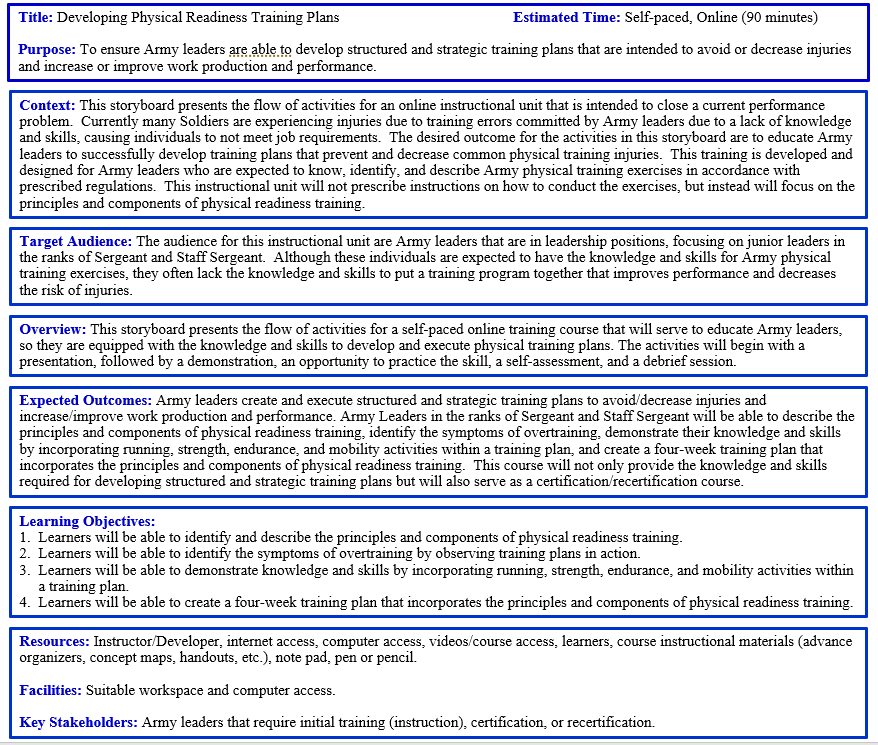
Storyboard Activity: Completed this activity yesterday, went back and reviewed the materials and concluded to add the following. I do believe I have a good understanding for this project, especially because I already completed IDE 631.
- Narration – Performance problem with proposed instructional solution, audience (Army leaders-advance), online. Resources needed: Internet, computer access, videos/course access, learners, note pad, pen or pencil.
- Flow chart – Already created above, just need to add times for each (30 min – presentation, 15 min – demonstration, 15 min – practice, 15 min assessment, and 10 min debrief/survey.
- Storyboard screens detailing each activity.
Ideas and notes from other classmates from their instructional unit they selected:
- Provide good explanation of the performance problem and content in the narration to ensure there is no confession who the audience is and there expected level of experience and knowledge.
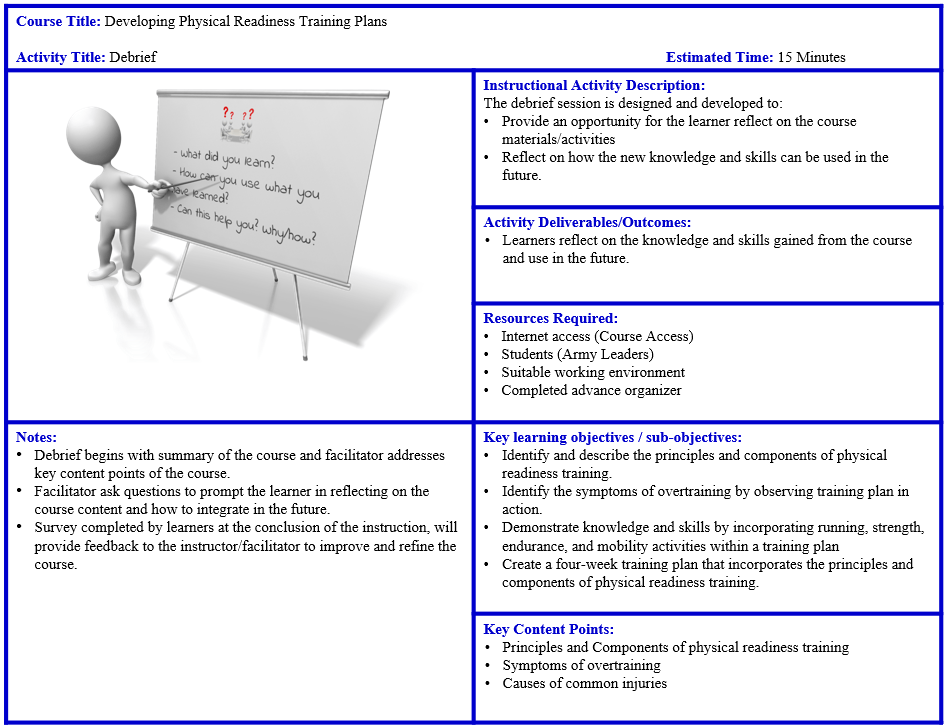
- Include job aid/handouts at the conclusion of the course (debrief section).
- Make sure you do not have to many learning objectives and ensure they fit within activities.
- Consider using self-check (provide rubric) for the assessment.
After presenting my instructional unit and receiving feedback in the first video session, I do believe I have a better and deeper understanding for this project, not so nervous any more and can’t wait for the final product. Looking forward to using the ideas and thoughts discussed in this course.
(Reading One) Merrill’s 5 First Principles – I remember reading this article in IDE 621, this was a great article and I truly believe in this concept. When I was thinking about my instructional unit and on my initial thoughts, I used the first principles to develop my initial thoughts on the activities.
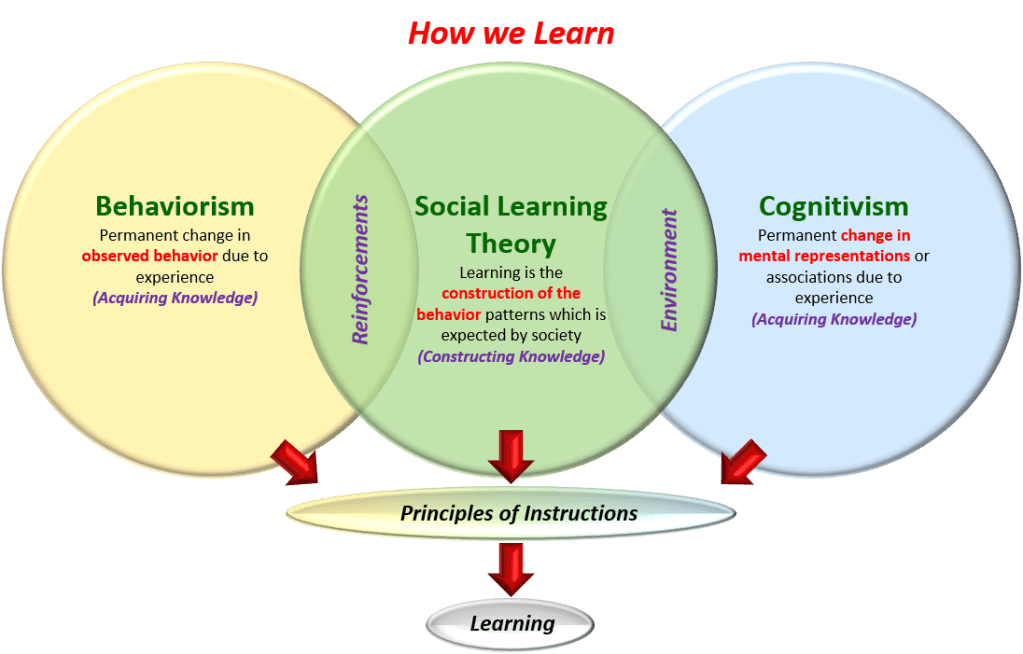
May 14, 2020
Initial Storyboard….

Today I worked on completing the first and second components (Narration and Flow of Activities) of my storyboard. Used my work from IDE 631 as an example for developing my current project. I also found myself using this reflection journal often as it had some of the original ideas I developed. So far I do believe I have a good initial instructional unit, with additional readings and input, this can be a great product. I have not read the assigned readings yet as I decided to complete my storyboard with the initial thoughts I currently have about my new instructional unit. This will allow me to enhance my instruction with the readings, input from video session two, and from other individuals from outside of the course. I also reached out to Patrick (colleague from previous course) for a review on my instructional unit. I plan to complete my initial storyboard by tomorrow, and send it to him for his initial review. I am scheduled for a video conference with Patrick next Thursday (21 May).
May 15, 2020
Today I worked on and completed my initial activity slides for my storyboard, which I will be sending to Patrick for his review (read ahead for next weeks session). While I was working on the activities I also decided to add an additional learning objective as I felt I originally left one out. Now have four. I do believe I have a good initial draft to share with the class and colleagues. Tomorrow (or Monday) I will conduct a critique of the storyboard using the rubric and guidance provided by the professor.
May 18, 2020
Readings….

(Reading Two) “Teaching by Fostering Learning Strategies: Focuses on three learning strategies which include Mnemonic Strategies, Structure Strategies and Generative Strategies.
Learning Strategy – Cognitive process performed at the time of learning to improve learning.
- Mnemonic Strategy: Keyword method (Should include Keyword Pictures as well). Elaboration Strategy includes creating stories.
- Structure Strategies: Technique to mentally organize information. Mapping Strategy: Graphic outlines, Knowledge mapping, flow charts, spatial learning strategy, concept mapping (graphic representation). Outlining Strategies: (five-level structures-description, sequence, causation, problem/solution, and comparison).
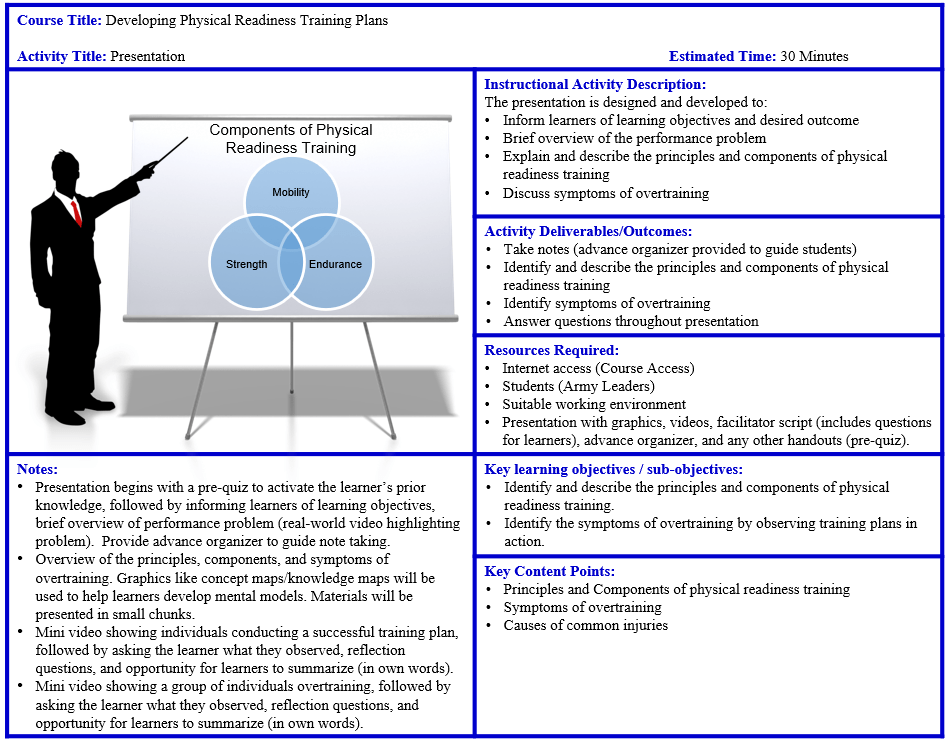
After completing this reading, I have concluded I should include graphics developed to use during the presentation that can assist learners in recalling and learning the information. These should include concept mapping or knowledge mapping.
(Reading Three) “Teaching by fostering learning strategies”
Generative Strategies: Integrating new knowledge with existing knowledge (meaningful learning). Intended to promote deep understanding by prompting learner to out material into own words. Summarizing Strategies: Summarizing note taking in own words. Questioning Strategies: example, asking yourself questions while you read or listen to text, use self-explanation method.
Self-regulated learning strategies: Learners who manage their learning activities.
After completing this reading, I have concluded I should include questions at the end of each activity should focus on the student reflecting on the content given and summarize the content in their own words. This will increase the likely of the learner linking the new information with previous knowledge/experiences, thus providing the learner with meaningful learning. (Include thought provoking questions with hint questions to stimulate the cognitive process).
(Reading Four) “Authenticity, self-regulation, and reflection learning”
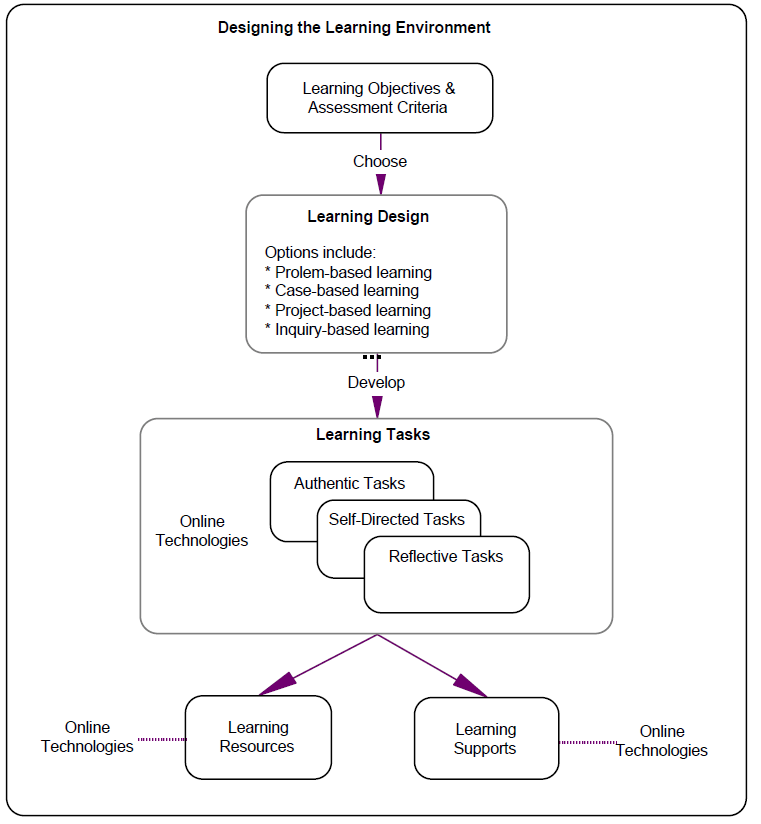
Learning environments need to focus on the learn (student-centered) like feedback, dialogue, reflection, and task oriented activities. Five conditions for learning:
- Complex, rich learning environments that incorporate authentic activity
- Social negotiation as an integral part of learning
- Multiple juxtapositions of instructional content (i.e. examining the same material from multiple perspectives)
- Nurturance of reflexivity
- Emphasis on student-centered instruction
Three elements describe understanding and comprehension (learning):
Self-regulated learning: actively participate in own learning, managing activities for oneself. (setting goals, priorities, learning methods, etc.)
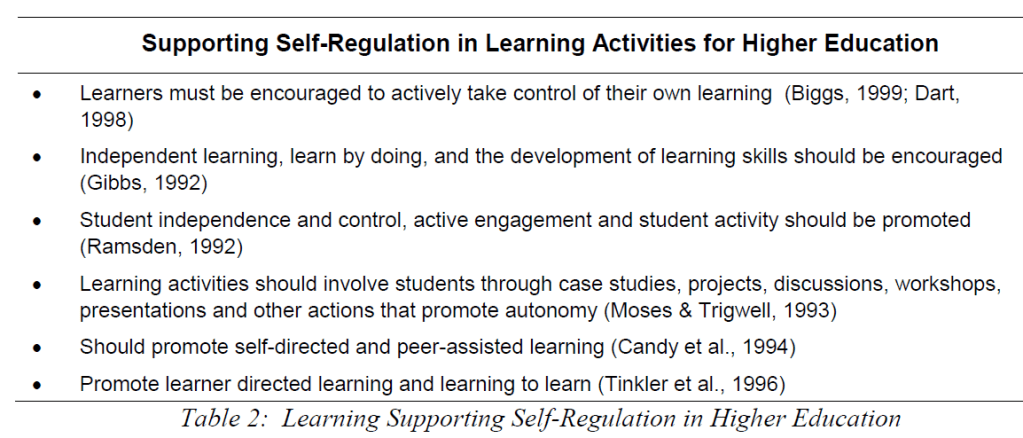
Reflection: the act of thinking about past and future events and how they can be used, the connection between various elements.
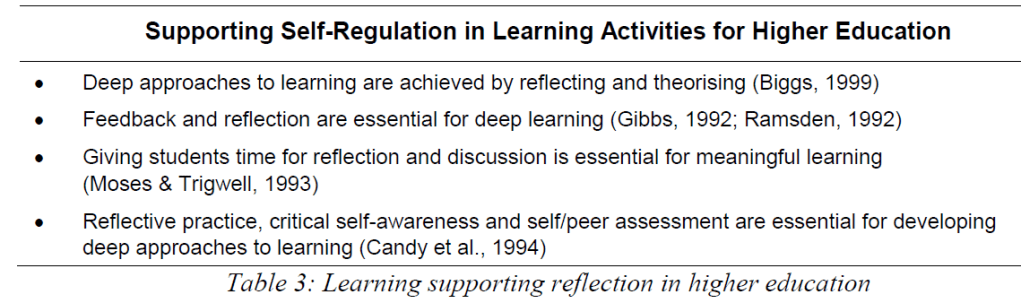
Authenticity: Content learned is being used (real-world).
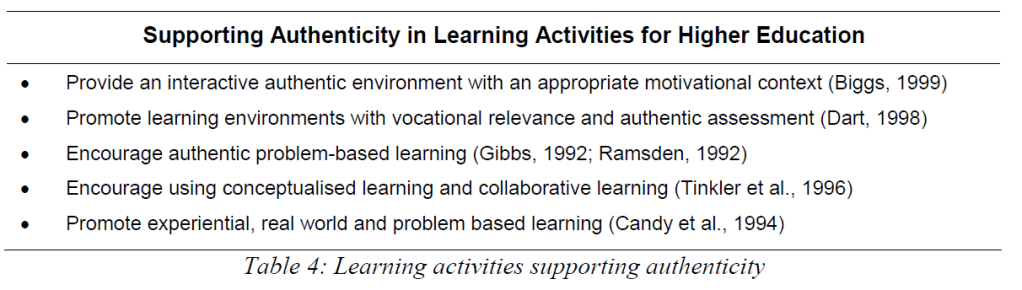
Framework for Designing Learning environment.
(Reading Five) “Enhancing teaching and student activities”
More than one answer… Make lectures more meaningful…. State objectives upfront, this article provided a lot of techniques to enhance learning and engage students in learning.
After completing this reading, I have concluded I need to ensure I clarify to state objectives upfront, prior to beginning the presentation. Divide presentation into two mini parts, (principles and components), asked learners to reflect and summarize content at the conclusion of each section. In the beginning of the presentation, include recommend to take notes or complete reflection/learning journal.
(Reading Six) “Contextualized teaching and learning”
Contextual Teaching and Learning (CTL) – The connection between the new knowledge and how it is applied in the real-world. (Examples of learning strategies: Problem-based, location based, on the job training)
After completing this reading, I have concluded I should include a video at the beginning of the presentation when addressing the performance problem. Ensuring the video represents a real-world example that is familiar to the learner.
Initial Rubrics….
Today I started to critique my initial instructional unit using the guidance and rubrics provided by the professor.

The rubrics assisted in ensuring that I have captured all the requirements for the developed instructional unit. While going through the checklist, I did document that I probably need to ensure the performance gap is a little more clearly stated. I did address the performance problem but I would like to ensure the gap is clearly stated. Another issue that I noticed was I am missing a learning objective (added while working on activities) in the narration. I will also need to ensure the instructional activity description is in bullet list format as stated in the checklist, not all activities currently have this format. These changes have been made on my enhance version of the instructional unit.
May 19, 2020
Today I continued to work on critiquing my instructional unit with the remainder of the rubrics provided. Based off the rubrics, I do believe I my initial thoughts have achieved the desired outcome in regards to learning design. I included several activities and questions throughout the instructional unit that will prompt and engage learners in the material. Below are a few strengths and areas that I will need to improve to enhance my instructional unit based off the three rubrics provided. Changes have been made based off the rubric in an effort to enhance my instructional unit.
Overall Strengths:
- Initial draft included all major requirements
- Good use of graphics throughout storyboard
Overall areas need improvement:
- Need to ensure performance gap is clearly stated
- Narration missing one learning objective
- Need to ensure in the presentation activity that it is clearly stated, learning objectives need to be upfront (beginning).
- Need to include reference page for images/graphics, books, and articles used.
Feedback, Learner Perspective….

Below was the input received from the perspective of the learner. Individual that provided this information is a graduate student and had the opportunity to serve in the Army for 12 years, 9 which were as an Army leader. Changes have been made based off the feedback received in an effort to enhance my instructional unit.
- Made a few grammar corrections throughout storyboard
- In the presentation activity, recommended that the video showing individuals conducting a successful session should come before the video showing individuals over training. Rational was, learners need to be shown what is correct before addressing the mistakes in the video.
- Time for each activity is good, and great flow with activities.
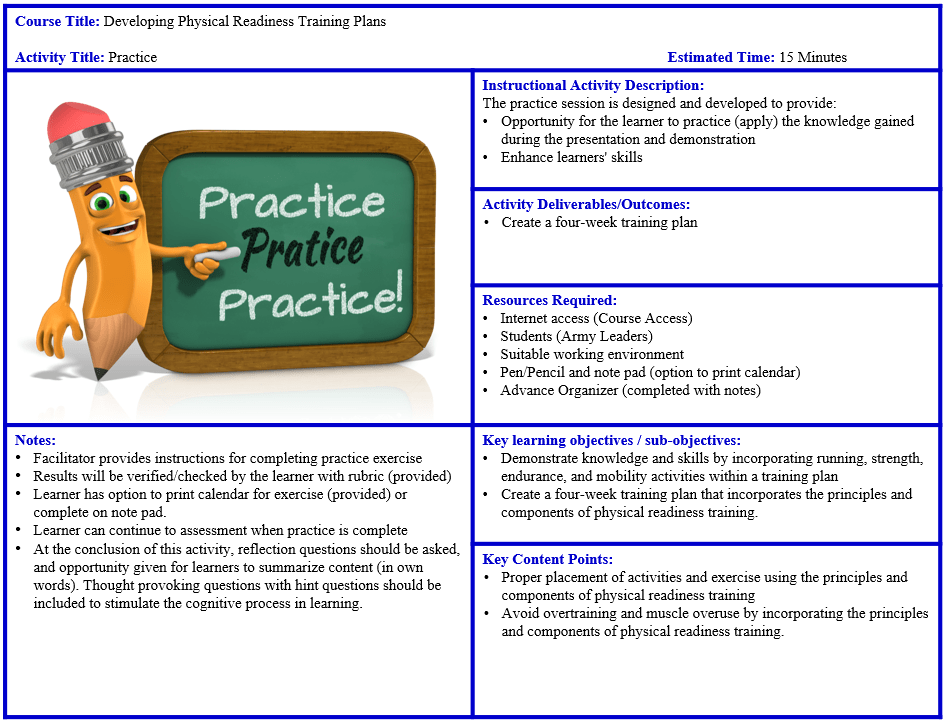
- Good use of showing examples, demonstrating, and opportunity to practice.
May 20, 2020
Video Session Two….
Today I will be participating in video session two where we will have an opportunity to present our storyboard to the professor and my other classmates. This is a great opportunity to receive feedback from the professor and my classmates. Additionally, I will have an opportunity to hear and observe the work of other students, this can give me ideas and possibly enhance my instructional unit.
Storyboard Feedback: Overall received positive comments from the professor and my classmates. Below are a few comments received.
- Flow chart – great visual and use of colors. Easy to follow and understand.
- Performance Problem is a real-world problem, great topic.
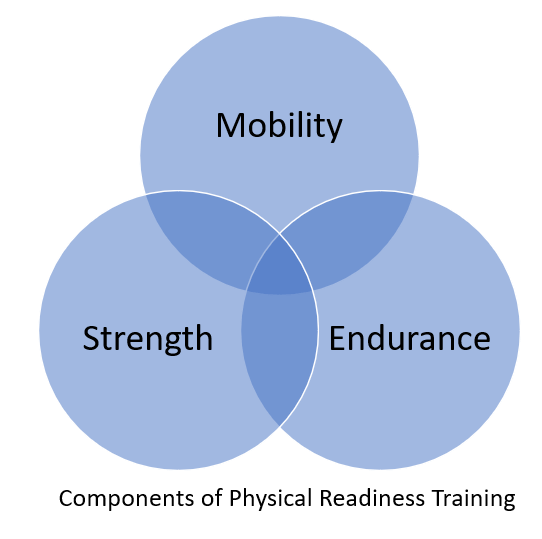
- Presentation Slide – Great graphic, should be used as a tool throughout instruction.
- Recommended using rubric for self-assessment. Already included in the instructional unit.
Storyboard Notes from other Classmates:
- Add survey at the conclusion of the debrief session.
- Add an block for objectives in the narrative. Currently mentioned on expected outcome but creating a specific block will help with clarifying what the learning objectives are.
Changes and updates have been made on my enhanced instructional unit based off the feedback I received from the video session and with the ideas from other presentations.
May 21, 2020
Feedback, ID Perspective….
Today I conducted a video conference with Pat, who is a student pursuing a certificate in advance studies in IDD&E (non-military). The following comments and recommendations were taken from the conference. Changes and updates have been made on my enhance instructional unit with the recommendations taken from Pat. He was able to provide some comments and recommendations from his perspective.
- Narrative was good but target audience was not clear. In an effort to clarify any confusion on the target audience, I added I block in the narrative that specifically addresses the target audience. This should provide a clearer picture, especially for non-military personnel.
- Certification/re certification unclear in narrative. In an effort to eliminate any confusion, I have clarified and expanded on the purpose of the course (educate, certify, and re certify) in the expected outcomes.
- Presentation: Recommended to provide advance/graphic organizer to guide and assist learners on taking notes, therefore enhancing learning and the ability to retain the new information received from the course. I have added the advance organizer in the presentation slide. I thought this was a great idea and addition to the learning strategies already included.
- Practice: Recommended to clarify in the “Key Contents Points” how the learner will avoid over training and muscle overuse. Added additional verbiage to assist the developer in highlighting the how and eliminate confusion.
Overall, I thought the comments and recommendations I received from Pat were a great addition to my instructional unit. It also served as a good opportunity to have a review from a non-military individual to ensure the information flowed correctly and made sense. I have made the changes to my instructional unit and am very pleased with the feedback I received so far.
May 25, 2020
Feedback, Instructor Perspective….
Today I received feedback on my current version of my instructional unit from Ms. Theresa Spagna, who is the Chair for the Department of Force Management at the Sergeant’s Major Academy here on Fort Bliss. Ms. Spagna has an educational background as an instructional designer and also several years of teaching at the Sergeant’s Major Academy. Below are the recommendations and comments by Ms. Spagna.
- Few grammar and spelling corrections
- In the presentation slide, recommended to include the advance organizer and all other handouts in the “resources required” section.
- Recommended to incorporate a pre-quiz to activate the learners prior knowledge.
- “Overall, with this being an online lesson, you have provided a good layout with good instructional strategies. Delivering the content in smaller chunks works well to alleviate cognitive load. Also, you have provided learning that meets the different learning styles which is always good. Using a combination of media types is more effective.”
Overall, I believe Ms. Spagna provide valuable input and recommendations to enhance my instructional unit. Changes and corrections have been made on my enhance instructional unit and I am very pleased and grateful for the input, not only from Ms. Spagna but from all others as well.
May 28, 2020
Second/Final Critique (Rubric)….
Today I will complete my second critique to prepare for video session three. I do believe I have completed a pretty good product, especially by using the comments and feedback that were provide by the professor, classmates, peers, other instructional designers, and instructors. The following were the highlights of my second critique using the provide rubrics. Comments in my initial critique were in red and blue for my second critique.
- Storyboard Checklist – In my initial critique I did lack clarity in the performance problem and format was incorrect in the instructional activities. Corrections/revisions were made.
- Advance Instructional Design (Learning Design Rubric) – After critiquing my enhanced version, I did make some modifications in my rating. I also added comments in each block to justify my rating.
- Advance Instructional Design (Instruction and Message Design Rubric) – After critiquing my enhanced version, I did make some modifications in my rating. I also added comments in each block to justify my rating.
- Advance Instructional Design (Designing and Enhancing Instruction from multiple Perspectives) – There were a few areas that were rated as “Partly” in my initial critique, but with the revisions/enhancements, these areas were changed to “yes”.
Overall, I do believe this final product is better than my initial version. I was able to gather input and feedback from many professionals which guided my development in enhancing this instructional unit. I was able to view and listen from several perspectives (ID, instructor, learner). At this time, I do believe I am ready for video session three.
June 03, 2020
Video Session Three (Optional)….
Although this video session was optional I decided to attend as I believe I can get a benefit by hearing others present their storyboard. I have already received a lot of comments and feedback from VS1, VS2, and from three individuals outside of the course and believe that I have a pretty good product. My intent is to submit my storyboard, final critique, and my reflection journal at the conclusion of this video session, pending any last minute changes/additions.
Final Storyboard….

Final Comments….
At the beginning of the course I was a little nervous on developing my own instructional unit, but after completing the activities (VS, presentations, readings, journal, and feedback) throughout the course, I am very confident on my final product. Creating my own instructional unit was a great and wonderful activity to practice the knowledge and skills I have gained throughout the IDD&E program. Presenting my instructional unit in the video sessions was a great opportunity to receive feedback and comments from the professor and my classmates. Reaching out to individuals outside the course also provided valuable input to enhance my instructional unit. When comparing the initial version to the enhance version, I was able to notice a lot of valuable changes that did enhance my original instructional unit. Lastly, using a reflection journal to document my work and changes throughout this project provided a valuable learning experience.
References

Department of the Army. (2012). Army physical readiness training (FM 7-22). Retrieved from https://armypubs.army.mil/epubs/DR_pubs/DR_a/pdf/web/ARN7938_FM%207-22%20INC%20C1%20Final.pdf
Icons made by https://www.presentermedia.com/
Luca, J., & Oliver, R. (2002) Developing an instructional design strategy to support generic skills development. Proceedings of the 19th Annual Conference of the Australiasian Society for Computers in Learning in Tertiary Education. Auckland, New Zealand.
Mayer, R. E. (2008). Learning and Instruction. Upper Saddle River, NJ:Pearson. (pp. 413-427 PART 2)
Merrill, D.M. (2000). First principles of instruction. Educational Technology Research and Development
 Billy J. Atkinson